About market intelligence engineering
Seventeen years working in B2B growth and GTM has taught me that the quality of decisions is almost always constrained by the quality of information feeding them.
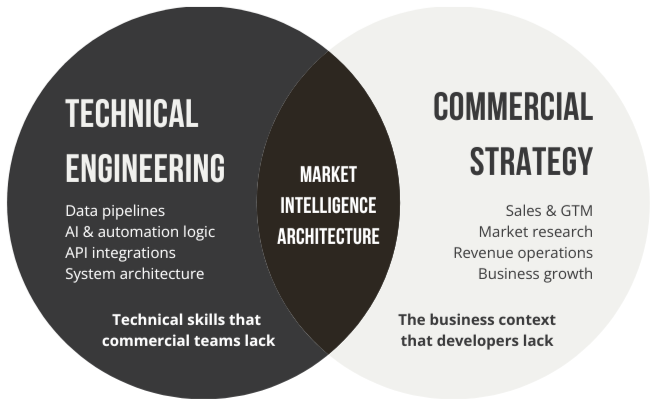
GTM, RevOps and market strategy all rely on external inputs…
Understanding markets, competitors, customers and signals - yet this intelligence layer is still largely handled through slow, manual research.
Your market strategy is only as good as the information it’s built on.
The ‘Complexity Tax’ of Manual Research
Most commercial teams scale research linearly.
If you want to understand twice as many companies, competitors or market movements, you need twice the people. As headcount grows, coordination costs rise, data becomes inconsistent, and effort is duplicated.
Over time, teams spend more energy managing research than using it.
The result is not better decisions, but higher cost and slower response.
The Solution: Changing the Maths
Market intelligence automation changes this dynamic entirely.
By automating the collection, verification and structuring of external market information, teams remove the primary constraint on their decision-making: access to timely, reliable insight.
Instead of one-off research exercises, you gain a continuously updated view of the market.
Instead of analysts and SDRs spending hours gathering information, they focus on interpretation, prioritisation and action.
Intelligence as leverage
The goal of automation is not to replace human judgment.
It is to remove the low-value friction that prevents skilled people from applying that judgment effectively.
When research and data hygiene are automated, each strategist, analyst or GTM operator operates with far greater leverage - working from a shared, current and reliable picture of the market.
This shifts teams away from labour-intensive research and toward insight-driven execution.
A different way to support GTM and market decisions
I help teams replace fragmented, manual research with ongoing market and competitor intelligence.
The underlying systems remain invisible.
What clients receive is clarity: structured insight, timely signals and a more accurate understanding of what is happening in their market.
If you want your GTM, RevOps or research processes engineered for leverage, instead of just managed, let’s have a conversation.”